01 Safety first
Electricity can kill. A current of only 50 mA through the body can stop the heart. Solar panels produce power whenever the sun shines — you cannot switch off the sun.
The 5 rules before working on any electrical installation
- Disconnect. Switch off breakers, remove fuses, open the main switch and the DC isolator.
- Secure against reconnection. Lock the switch or take the fuses with you. Put up a warning sign.
- Test for absence of voltage. Use a two-pole voltage tester. Never trust a switch position alone.
- Earth and short-circuit (for systems above 1000 V and overhead lines).
- Cover nearby live parts with insulating material before you start.
Working on roofs
- Use fall protection when working near a roof edge above 2 m: guardrails first, harness with anchor point if guardrails are not possible.
- Check the roof structure before loading it with panels and people. Old timber or rusted sheets may not carry the weight.
- Never work on a metal roof during thunderstorms. Stop work when rain makes the roof slippery.
- Wear a helmet, gloves and shoes with grip. Keep tools tied or in a bag — a falling spanner can injure people below.
02 Electricity basics
Three quantities describe every circuit: voltage U (volts), current I (amps) and resistance R (ohms).
Power P (watts) and energy E (watt-hours) are what customers pay for:
Series and parallel
- Series (panels in a string, cells in a battery bank): voltages add, current stays the same.
- Parallel (strings side by side): currents add, voltage stays the same.
03 The sun in Ghana
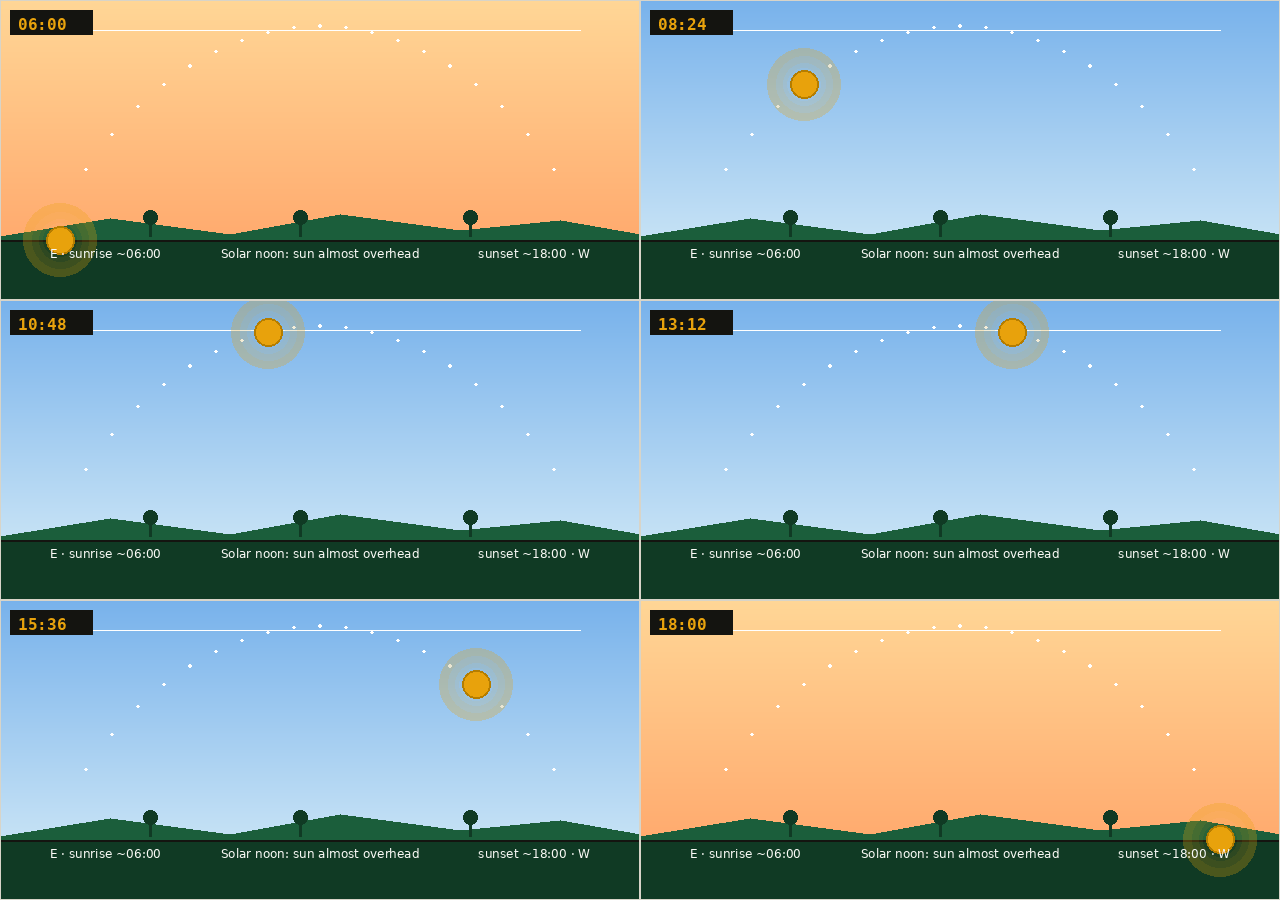
Ghana has an excellent solar resource: roughly 4.5 to 5.5 peak sun hours (PSH) per day, depending on region and season. One peak sun hour equals 1000 W/m² of sunshine for one hour.
- North (Tamale, Bolgatanga): ~5.0–5.5 PSH — very strong, drier climate.
- Middle belt (Kumasi): ~4.5–5.0 PSH — more clouds in the rainy seasons.
- Coast (Accra, Takoradi): ~4.5–5.0 PSH.
Tilt and orientation
- Ghana lies close to the equator (5–11° N). The yearly optimum tilt is small — about equal to the latitude.
- Use at least 10° tilt anyway, so rain can wash dust off the panels. Flat panels stay dirty and lose power.
- Face the modules towards the south where possible; east or west costs only a little yield at this latitude.
- Avoid all shade between 9:00 and 15:00 — trees, water tanks, antennas, parapet walls. Even a small shadow can cut a whole string's output.
- Open the link, then click your project's location on the map (or search an address/enter coordinates directly).
- Under "Performance of Grid-connected PV", choose Grid-connected for grid-tied and hybrid systems, or Off-grid for stand-alone systems.
- Enter the installed PV power (Wp), system losses (start around 14 %, increase for heat and dust), mounting type (free-standing or building-integrated) and the slope/orientation you're planning.
- Click "Calculate": PVGIS returns the estimated monthly and yearly energy yield (kWh), the average daily irradiation, and lets you compare tilt/orientation combinations to find the best fit for the roof.
04 System types
| Type | How it works | Best for |
|---|---|---|
| Grid-tied | Inverter feeds solar power into the building and the grid. No battery. Shuts down when the grid fails (anti-islanding). | Businesses and homes with a reliable grid connection and net metering. |
| Off-grid (stand-alone) | Panels charge a battery through a charge controller; an inverter supplies the loads. No grid at all. | Rural homes, farms, telecom sites, clinics without grid access. |
| Hybrid | Solar + battery + grid (and often a generator). The battery bridges power cuts; solar reduces the bill. | Areas with frequent "dumsor" power cuts — the most common choice in Ghana. |
Charge controllers
- PWM: cheap, fine for small systems where panel voltage matches battery voltage.
- MPPT: 10–30 % more harvest, allows higher panel voltage and longer cable runs. Recommended for most systems.
Batteries
- LiFePO4 (lithium): long life (3000+ cycles), 80–90 % usable depth of discharge, safe chemistry, no maintenance. Best value over its lifetime.
- Lead-acid / gel: cheaper to buy, but only ~50 % usable and shorter life, especially in heat. Keep them cool, ventilated and charged.
- Heat shortens battery life. Install batteries in the coolest, shaded, ventilated place available — never in direct sun or a hot metal container.
05 Sizing a system — step by step
Step 1 — Daily energy need
List every load: power (W) × hours per day = watt-hours (Wh). Add them up.
E_daily [Wh] = Σ ( P_load × hours )Example: 4 LED lamps 10 W × 5 h = 200 Wh · TV 60 W × 4 h = 240 Wh · fridge ≈ 800 Wh · phone charging 30 Wh → ≈ 1270 Wh/day.
Step 2 — Solar array
P_array [Wp] = E_daily / ( PSH × PR )PR is the performance ratio: use 0.70 for battery systems (heat, dust, cable, charging and inverter losses), 0.75–0.80 for grid-tied.
Step 3 — Battery bank
C [Ah] = ( E_daily × days of autonomy ) / ( U_battery × DoD × η )Days of autonomy: 1–2 for hybrid with grid backup, 2–3 for full off-grid. DoD: 0.8 for lithium, 0.5 for lead-acid. η (battery + inverter efficiency): ≈ 0.85.
Step 4 — Inverter
Inverter power ≥ the sum of loads that run at the same time, plus reserve for motor start-up (fridges and pumps need 3–5 × their rated power for a moment). Choose a pure sine wave inverter.
Step 5 — Cables
A [mm²] = ( 2 × L × I ) / ( 56 × ΔU )L = one-way cable length in m, I = current in A, ΔU = allowed voltage drop in volts (aim for max. 3 % on the battery side — that is only 0.36 V in a 12 V system!). 56 is the conductivity of copper. Low-voltage battery systems need thick cables.
⚡ System sizing calculator
Guide values with PR = 0.70 and system efficiency 0.85. Always check against the real datasheets and local conditions.
06 Installation best practice
Mounting
- Fix the rails to the roof structure (rafters/purlins), never only to the roofing sheet.
- Use stainless or hot-dip galvanised hardware — coastal air and rainy seasons corrode ordinary steel fast.
- Do not mix bare aluminium and copper directly: galvanic corrosion. Use suitable bimetal or stainless connectors.
- Clamp modules only in the zones the manufacturer allows. Torque the clamps to specification.
Wiring
- Use UV-resistant solar cable (PV1-F type) outdoors and genuine, matching MC4 connectors — never mix brands or improvise with tape.
- Fix cables every 30–50 cm; no cable should touch the hot roof sheet or hang in water.
- Fuse every parallel string when more than two strings share one input.
- Keep DC plus and minus of the same string together (small loop area = less lightning-induced voltage).
Earthing and lightning
- Bond the module frames and mounting rails to earth (min. 6 mm² copper, 10–16 mm² for larger systems).
- Install surge protection (SPD Type 2) on the DC side near the inverter and on the AC side — thunderstorms are frequent and intense in Ghana.
- Drive a proper earth rod; measure the earth resistance, do not guess.
07 Maintenance
- Clean the modules with water and a soft brush early in the morning — never with cold water on hot glass. More often during Harmattan.
- Check yields monthly. A sudden drop means shading, dirt, a failed string or a tripped fuse.
- Inspect yearly: connectors (discoloured = hot = danger), cable fixings, corrosion on the mounting, tightness of clamps, surge protectors (replace after big strikes), inverter error log.
- Batteries: keep terminals clean and tight; for lead-acid check electrolyte level and equalise as the maker specifies; keep the room ventilated.
- Cut back trees and bushes before they shade the array.
08 Quick reference
Copper cable — maximum current (guide values)
| Cross-section | Max. current |
|---|---|
| 2.5 mm² | 16 A |
| 4 mm² | 20 A |
| 6 mm² | 25 A |
| 10 mm² | 40 A |
| 16 mm² | 63 A |
Derate in hot conduits and bundles. For battery cables, the voltage drop usually decides, not the current rating.
Key formulas
| What | Formula |
|---|---|
| Power | P = U × I |
| Energy | E = P × t |
| Array size | Wp = Wh/day ÷ (PSH × 0.7) |
| Battery | Ah = Wh × days ÷ (V × DoD × 0.85) |
| Cable size | mm² = 2 × L × I ÷ (56 × ΔU) |
| Max. string voltage | U = Uoc × n × 1.02 (cool mornings raise Uoc — stay below the inverter/controller limit) |
Typical loads
| Appliance | Power | Typical Wh/day |
|---|---|---|
| LED lamp | 5–12 W | 25–60 |
| Phone charger | 10 W | 20–40 |
| Fan (standing) | 50–70 W | 300–500 |
| TV (LED, 32") | 40–60 W | 150–300 |
| Fridge (efficient) | 100–150 W | 600–1200 |
| Water pump (small) | 370–750 W | depends on use |
| Air conditioner (1 HP) | ~900 W | 3000–7000 |